















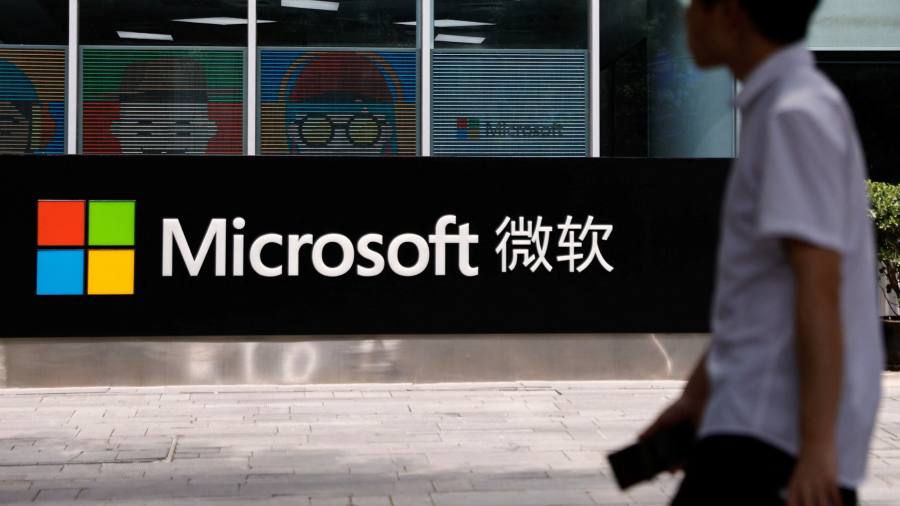

Microsoft is moving some of its best artificial intelligence researchers from China to Canada, putting at risk an essential training ground for the Asian country’s tech talent.
Beijing-based Microsoft Research Asia (MSRA) has begun seeking visas for top AI experts to move from the Chinese capital to its institute in Vancouver, said four people with knowledge of the plans.
These people said that 20 to 40 employees may be affected by the move. A person close to Microsoft said fewer Chinese workers will move to Canada this year, where the US tech giant is building a new lab staffed by experts from around the world.
The researchers described the move as the “Vancouver Plan”. Those with knowledge of the decision described it as a response to rising political tensions between the US and China, as well as a defensive maneuver to prevent top talent from being poached by domestic tech groups for AI researchers. Desperate to develop native versions of OpenAI’s ChatGPT.
After this article was first published, Microsoft said: “The reported numbers are not accurate. There is no ‘so-called Vancouver plan’.
The company said on Friday that: “We are establishing a new lab in Vancouver that will be organizationally aligned with MSRA and designed to better engage with the engineering teams in Vancouver. To include China The lab will house people from other MSR labs around the world.
Two MSRA researchers said they recently received job offers from Chinese Internet companies, but turned down the approach and are instead applying for visas to move to Canada.
“Even though Microsoft has deep ties with China, there is a risk of having our best researchers here, especially those working in machine learning,” said one of the researchers. “There is a risk of talent poaching by Chinese companies or employees being harassed by authorities. We have discussed these risks in internal meetings.”
A second Microsoft researcher, who applied for a Canadian visa, also said: “Perhaps in a third country outside the US and China, we can recapture the vibrant tech discussion of the old days.”
Any decision to relocate top AI researchers risks provoking Beijing, which has sought to lure high-tech Chinese researchers working overseas back to the mainland through generous grants and prestigious teaching positions.
Founded by Taiwanese computer scientist Li Kai-fu, the MSRA has been an important training center for Chinese technical talent. Its star-studded alumni list includes Wang Jian, chief technology officer at Alibaba, Xu Li, head of Sensetime, and Yin Qi, head of AI group Magvi.
“MSRA’s contribution to AI has been phenomenal,” said a technology consultant in China who previously worked with Microsoft. “It has been operating in the area for a long time. Many former colleagues have joined Chinese tech companies and boosted the overall AI ecosystem in China.
Microsoft has been in China for over three decades. It has maintained a strong presence in the country even as other Western tech conglomerates including Google, eBay, Facebook and Uber have been forced out by competition or regulation.
Microsoft has developed popular local products including its flagship Office and Windows software packages and the Bing search engine.
Microsoft had 9,000 employees in China, more than 80 percent of whom are software engineers or work in research and development, according to a company WeChat post in September. The same post announced plans to hire 1,000 more employees in the country.
But a vast majority of engineering talent in China works on global products, which could become increasingly problematic for the US company if relations between Beijing and Washington escalate further. A person close to the company said it is possible that some of these talented engineers may be moved out of China in the future.
LinkedIn, the Microsoft-owned conglomerate, laid off employees in its China office in May after announcing that it was shutting down InCareer, a job application site for Chinese users that had hired professionals in 2021. Changed social networking sites.
The MSRA stands out as a rare example of cooperation between China and the US in high-tech research. But two researchers said deteriorating relations between the two powers and paranoia about their respective technological ambitions have reduced their ability to cooperate with allies in the West and put them under greater scrutiny from officials in China. .
The institute was criticized by Washington after the Financial Times reported that it worked with a Chinese military-run university on AI research that could be used for surveillance and censorship.
“AI has become a so-called sensitive field in the past two years,” said a Chinese Microsoft researcher who applied for a Canadian visa. “Previously, being a Chinese citizen working in an American institution meant having access to great resources from both countries. The space for communication is shrinking.”
Additional reporting by Richard Waters in San Francisco


