
















New DelhiIndia, known for its rich cultural diversity, is home to around 2,500 tribes and regional groups. Various artefacts like paintings, sculptures, pottery, seals and tablets with intricate artwork and skillful craftsmanship found during excavations at Harappa and Mohenjo-daro are testimony to the rich cultural heritage of India. Each art form found in the Indian states has its own distinctive style, rarity and uniqueness. Among those popular art forms, the art of the tribal communities of India is the most vibrant as they provide a glimpse of our rich cultural heritage.
Let’s take a look at some of the incredible tribal art forms of India.
Worli Folk Painting: This tribal art dating back to 2500 BC is famous for its early wall paintings. This art form found near the Western Ghats of India is one of the finest examples of folk painting. Mainly practiced by the Warli tribe, this art form mainly depicts the nature and social rituals of the tribes in basic geometrical shapes like – square, circle and triangle. These paintings have been carved using bamboo brushes in white on a dark red background. This painting portrays the daily activities of tribal life like hunting, festivals, fishing, farming, dance etc.
Gond Art: This art form was popularized by the Gond tribe, which is scattered in central India. This art is engraved on the mud walls. Gond art or painting is done to communicate and preserve the culture of the Gond tribal community. In this art form, painting is done on paper, canvas, cloth etc. Lines, dots and dashes are important features of Gond art. These paintings are so good in quality that they can last for almost 20 years without any tampering.
Kavad Art: This 500 year old art was mainly practiced by Jangid Brahmins of Chittorgarh, Rajasthan. It is a three-dimensional, multi-paneled box or portable temple that can be opened. Many deities have been depicted by the artists on this portable temple. These portable temple panels are made of light wood and mostly depict stories from popular epics like Ramayana, Puranas and Bhagavad Gita.
Bhil Art: This art form was developed by the Bhils, who are the second largest tribal community in India. This art form depicting the life of Bhils is prevalent in the states of Madhya Pradesh, Rajasthan, Gujarat and Maharashtra. The Bhils used dots to depict various aspects of their lives using vibrant colours. It was also a way for them to connect with their deities and nature. These paintings usually focus on natural elements like sun, moon, deities and nature. Mostly herbal colors are used to complete these paintings on mud walls or paper. Bhil artists used neem sticks and twigs to paint nature using natural colours.
Kalamkari: Kalamkari literally means “pen drawings”. This art form, very popular in Andhra Pradesh, is more than 3000 years old. Two distinct styles of Kalamkari exist in India today – ‘Machilipatnam’ and ‘Srikalahasti.’ In the Kalamkari form of painting, fine bamboo pens are used by the artists to express their art. This art form flourished during the reign of the Golconda Sultans and also showed Persian influence. These days, kalamkari painting on clothes is a popular apparel style, and it usually depicts scenes from the epics like Ramayana and Mahabharata.
Tanjore Painting: This incredible art form originated in the city of Thanjavur in the state of Tamil Nadu. This art form, which was first developed in the late 16th century, is truly a celebration of the region’s rich artistic tradition. This classical South-Indian art form is noted for its extensive use of vibrant colours, glass, stones and gold foil. These paintings, which mostly depict Hindu deities, are carved on wooden boards made of teak wood or jackfruit. The deities depicted in these paintings generally have round faces and oval shaped eyes and their main body is surrounded by an arch, curtain etc.
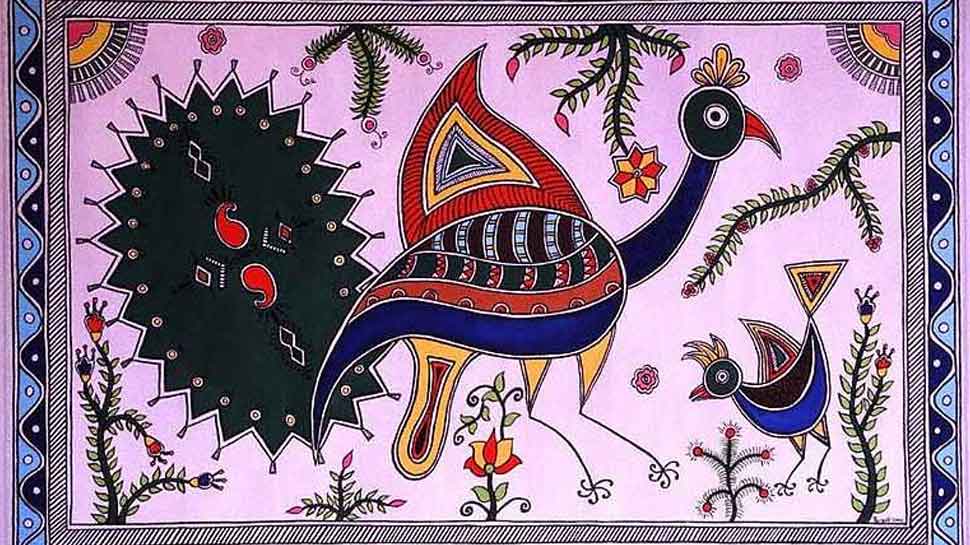
Madhubani Art: This art form, also known as Mithila art, is popular in present-day Bihar. This art was practiced by the women of Mithila. Madhubani paintings mostly include images of mythological figures, deities, flora and fauna. The paintings are made on freshly plastered mud walls, usually depicting nature or religious elements such as Shiva, Krishna, Saraswati, Rama, Durga, Surya, Moon, trees, flowers, animals, wedding scenes, etc. Brushes, twigs, fingers and matchsticks – Sticks containing natural dyes and pigments are used to complete the Madhubani painting.
Fad Art: With its roots in Rajasthan, this art form is primarily a religious style of scroll painting depicting folk deities Pabuji or Devnarayan. The canvas or cloth on which it is painted is called a phad and is often 30 or 15 feet long. In this style of painting vegetable colors are used to depict the heroic acts of the deities.
Pattachitra: One of the oldest forms, it dates back to the 5th century. It was very popular in Odisha and West Bengal. It is a cloth based painting that depicts deities. In ancient times this style of painting was used to tell a story. Pattachitra painting which literally means “paintings on canvas” focuses on religious and mythological subjects. This type of painting has a dominant color palette such as red, black, yellow, white and blue. This style of painting is very time consuming and can even take several months to complete.


