“Producing for food, nature and the climate” was a phrase often used by Defra’s Janet Hughes when she gave an insightful presentation to a packed hall at Groundswell 2023. Once a fringe event, the topics discussed at the Regenerative Farming Conference have rapidly become mainstream, with greater consensus developing on key issues.
flexible and customizable approach
Janet was keen to reassure farmers and others in the Big Top, that a less prescriptive approach would be adopted with the new Environmental Land Management Plans (ELMs) – offering more flexibility to choose and mix and match and create a tailored plan Will go that will work. Farm.
In particular, he talked about the Countryside Stewardship scheme and reiterated that it will be continued as it has been improved with farmer inputs and is now considered efficient. Defra aims to deliver its results through this scheme.
For sustainable farming promotion, learning points from over 4000 on-farm trials are being incorporated to expand the scope. The standards will not be ‘bundled’ as prepared earlier, but will be offered as a portfolio for farmers and their advisors to choose from.
She adds: “We are testing and learning as we go forward, with a ‘flex and adapt’ approach to make schemes good and fit for purpose, with farmers needing the ‘certainty’ they need to plan balancing.” Their vision is to develop an agricultural system with feedback loops that provide productivity and prosperity and promote food production and the environment.
He reassured the audience that 530 schemes had been accepted for the high level of Countryside Stewardship and that the standard was good. There are also plans to offer a hybrid approach to increase access and allow smaller projects within a wider middle tier scheme to be eligible for support under the higher tier.
They also acknowledged that there are a glut of grants and schemes and that Defra is looking at ways to make it easier to access and apply for relevant aid.
growing consent
The next session looked at how there is growing consensus on the direction of travel for farming.
The Food, Farming and Nature Consensus was developed from discussions at the Oxford Farming Conference, it aims to bring together all stakeholders to find common ground on tackling systemic issues.
All signatories to the pledge agreed on three shared principles:
- A healthy natural environment underlies food security.
- Along with food production, agriculture also plays an important role in dealing with nature, climate and health crisis.
- Diversity in all its forms will enable resilience and innovation in the face of growing economic and environmental challenges.
Following a scene-setting by RSPB director for global conservation, Katie-Jo Laxton, three political figures – the Rt Hon Lord Benyon (Con), Daniel Zeichner MP (Lab) and Stuart Roberts (Lib Dem) – spoke about how to proceed Gave my opinion. , and again a consensus emerged, reassuring those in the room that whatever the outcome of the general election, the path towards net zero would accelerate, not veer.
Daniel noted at a recent Agri-Techie event that the discussion was about establishing baselines to measure progress and making sure the community is doing the right thing in the best possible way. He stressed the importance of a land use framework that would create a consensus on how to optimize land use.
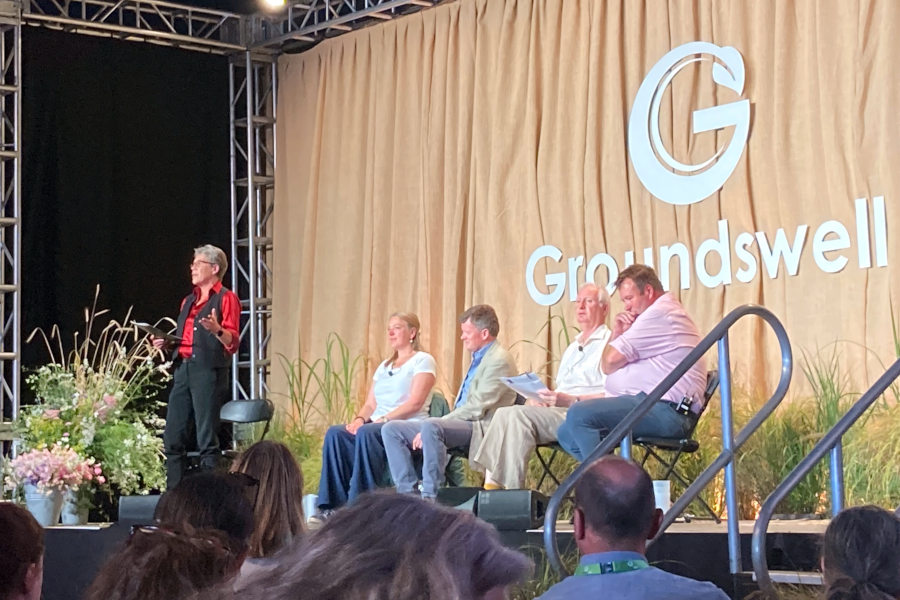
He also stressed the need for trade deals that would not allow UK farmers striving for higher standards in animal welfare and environmental management to be undervalued by foreign competitors operating in a less regulated landscape.
way to manage
Several Agri-Tekai members were performing at Groundswell, including: