/cdn.vox-cdn.com/uploads/chorus_asset/file/24016885/STK093_Google_04.jpg)


/cdn.vox-cdn.com/uploads/chorus_asset/file/24808816/Starfield__The_Settled_Systems___Supra_Et_Ultra_____Starfield__The_Settled_Systems___Supra_Et_Ultra_2023_7_25_94252.263_1440p_streamshot.png)










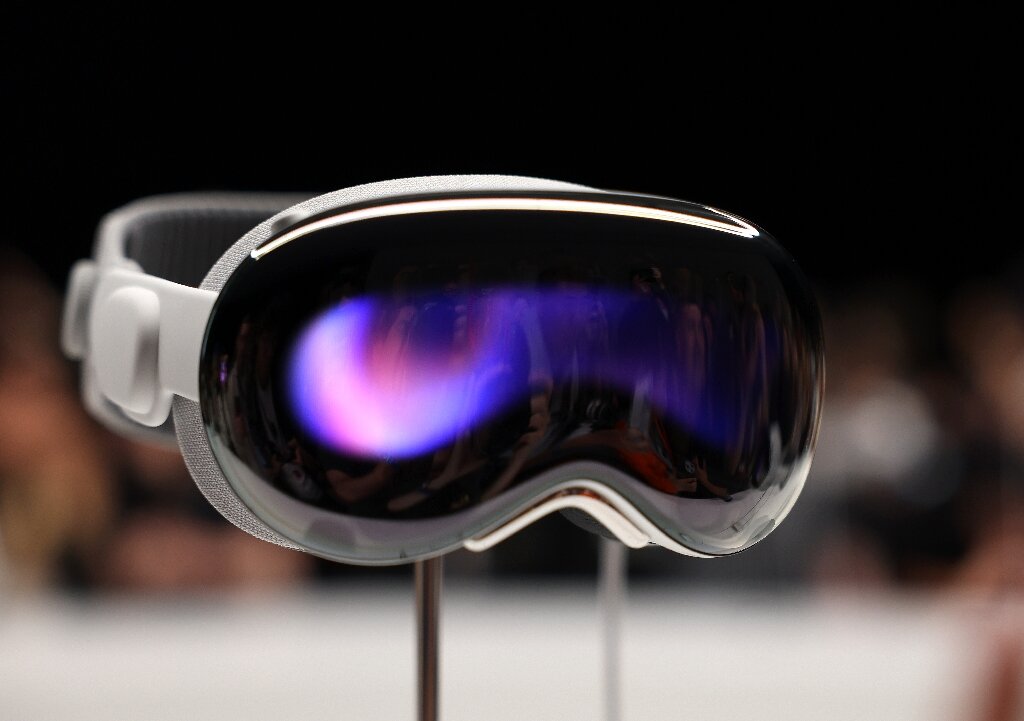

The new Apple Vision Pro headset will set buyers back $3,499.
Tech giant Apple has unveiled its first major product in more than seven years, a mixed-reality headset that could deal a terminal blow to the “metaverse”.
Silicon Valley rival Meta was so confident it could create the Metaverse—an idea of a 3D immersive internet—that it changed its name from Facebook in 2021 and began pouring billions into the project.
But the idea has been hampered by a fluffed launch, dodgy graphics, no clear path to profitability and a general feeling that very few people know what it is.
Meta’s Reality Labs, which is helping its metaverse effort, has lost $4 billion so far and company chief Mark Zuckerberg is increasingly talking artificial intelligence rather than the metaverse.
During his presentation on Monday, Apple boss Tim Cook introduced the Vision Pro, a sleek headset designed to resemble ski goggles.
This would allow the user to communicate, work, watch movies, listen to music—and even choose whether to remain immersed or monitor the outside world.
Cook didn’t explicitly mention the metaverse during the hour-long launch, instead promising Apple ushering in an era of “spatial computing.”
James Whatley, chief strategy officer at marketing agency Diva, said, “Tim Cook has gone on record saying that he doesn’t like using the term, that he doesn’t think it has any real meaning.”
“The faster Meta can get away from that word, the better positioned they will be to counter Apple’s encroachment into the space.”
‘A credible vision’
Meta could argue that its product still has an advantage over newcomer Apple.
The first and most obvious is the price—Apple’s Vision Pro weighs in at $3,499, which is twice the price of Meta’s top-of-the-range Quest Pro headset.
Tom Fiske, who runs the immersive Wire expert newsletter, pointed out that Apple was clearly pushing a different strategy to Meta.
He wrote, “Apple isn’t seeking to create a wider XR (extended reality) ecosystem with the Quest line-up like the Meta.”
“The company is instead looking to monetize an already lucrative subdivision of its audience with high-margin subscriptions and software.”
More broadly, he told AFP that Apple had such a high level of trust “that it legitimizes a product category”.
Martin Pearce of tech website The Information believed that Apple had modeled the Meta on the likes of defunct Canadian smartphone maker Blackberry.
He wrote that Apple had “provided a credible vision of the long-term potential of augmented reality”, a space it was well positioned to dominate at Meta’s expense.
‘Real world experience’
The smooth launch of Apple’s headset, complete with a funny video declaring it to be “like magic,” has laid down a clear marker.
Users were shown enjoying “cinematic” movie experiences, scrolling through 3D pictures and videos, moving through webpages with just a hand gesture, and linking to game consoles while joining FaceTime calls.
“Apple has rightly, and in a very traditionally Apple way, rooted it in real-world experiences,” Whatley said.
He contrasted this with Meta’s “creating a 3D avatar of himself with legs that may or may not exist in a world where there is nothing to do”.
Yet analysts were divided over whether such glasses would ever be rolled out to the wider public.
Google tried and failed to pretty much end its Google Glass experiment this year.
Meta’s Quest headset has failed to strike a chord with expert users and gamers.
But both Ffiske and Whatley stressed that the immersive technology is in its infancy and that eventually there will be enough space for the two Silicon Valley giants.
“Apple’s announcement will raise all boats in a tide, including Meta,” Fiske said.
© 2023 AFP
Citation: Apple reclaims the Metaverse (2023, June 6) Retrieved 6 June 2023
This document is subject to copyright. No part may be reproduced without written permission, except in any fair dealing for the purpose of private study or research. The content is provided for information purposes only.