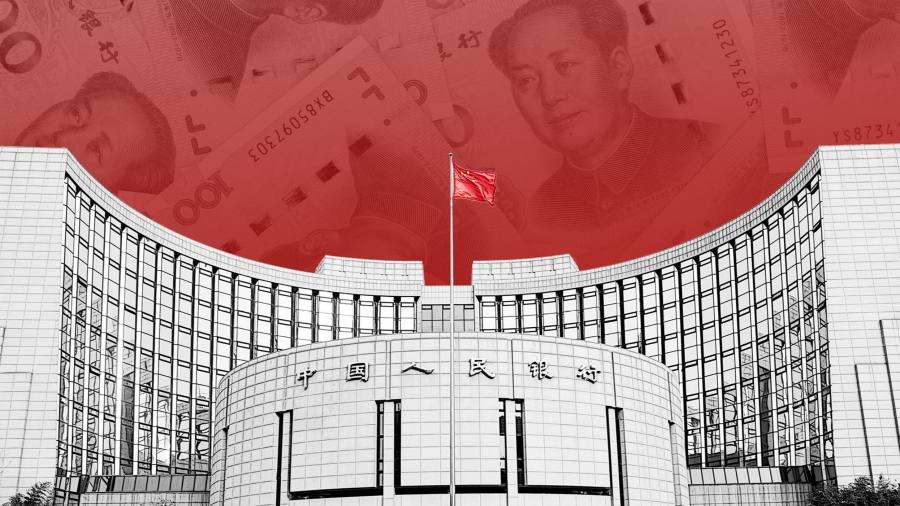

Shares in Asia rose after the People’s Bank of China cut medium-term policy rates on slowing economic growth and the US Federal Reserve kept interest rates steady.
The Hang Seng China Enterprises Index, which tracks mainland Chinese companies listed in Hong Kong, rose 1.4 percent and Shanghai’s CSI 300- and Shenzhen-listed shares added 0.5 percent. Japan’s Topix rose 0.4 per cent and Australia’s S&P/ASX 200 added 0.3 per cent.
The gains came after the PBOC cut its medium-term lending facility rate by 0.1 percentage point to 2.65 percent, the same amount earlier in the week that cut its seven-day lending rate, the first step to boost short-term lending. Was. Liquidity in the country’s interbank market in nine months.
The data released with the announcement underscored the slow pace of China’s economic recovery. Growth in industrial production and retail sales came in below economists’ expectations, while the pace of contraction in property investment and sales in May also worsened.
In currency markets, the renminbi weakened 0.3 percent to Rmb7.1807 against the dollar after the central bank cut, taking the currency down nearly 4 percent against the greenback for the year and to a new six-month low. ,
Analysts were skeptical that a medium-term rate cut, which serves as the floor for China’s benchmark prime loan rate, would be enough to get growth back on track.
“The underlying story on the economy right now is extremely gloomy,” said Robert Carnell, head of Asia-Pacific research at ING. He said the renminbi could weaken to Rmb7.2 against the dollar in “days” and that policymakers would consider the weaker currency “as one of the policy tools to help the economy.”
Gains in Asia It was a choppy day on Wall Street, where the benchmark S&P 500 edged 0.1 percent higher and the tech-focused Nasdaq Composite rose 0.4 percent after the Fed’s widely anticipated decision to leave the federal funds rate untouched on Tuesday. was given.
But the pause at the 5 to 5.25 percent range, after 14 months of rate hikes, came with forecasts from Fed officials that indicated most policymakers expect two more quarter-point hikes this year.
Economist Brian Martin at ANZ described the Fed’s decision as “abandoning aggression”, noting that while “there are some encouraging signs that the intensity of inflation is waning, it is too early to conclude that inflation is still driven by a strong labor market”. lost between”.
Hawkish outlook strengthened the dollar in Asian trade, with the dollar index tracking the US currency against a basket of other currencies, climbing 0.3 per cent.
Futures markets tipped the S&P 500 to open flat later in the day, while the FTSE 100 was expected to shed 0.3 per cent at the start of trading in London.