












China’s central bank cut its key policy rate for the first time in 10 months as new data reinforced concerns over the post-Covid-19 recovery in the world’s second-largest economy.
The People’s Bank of China lowered its medium-term lending facility rate, the one-year rate that affects bank funding costs, from 2.75 percent to 2.65 percent, amid widespread expectations that Beijing will do more to support the economy. Will be forced to take action.
The rate cut came after the central bank this week unexpectedly raised the seven-day reverse repo rate, a key gauge for short-term banking sector liquidity, and disclosed tax breaks for businesses.
The move, which was accompanied by a dismal data report for May, signaled official dissatisfaction with the state of the Chinese economy, which was widely expected to boom after authorities abandoned strict coronavirus controls at the start of the year .
But growth remains weak due to a slowdown in the property sector, weak demand for exports and a lack of business and consumer confidence.
“We haven’t seen a return to pre-pandemic levels of confidence,” said Julian Evans-Pritchard, China economist at Capital Economics.
Economists predict Chinese policymakers will roll out more support in the coming months, ranging from infrastructure funding to aid to local governments, which bore many of the costs of China’s three-year zero-Covid regime and Much depended on property development for revenue.
Chinese equities were broadly higher after the rate cut, but last month’s poor performance in retail sales and investment limited gains. The Hang Seng China Enterprises index of mainland Chinese companies listed in Hong Kong rose 1.4 percent, while the CSI 300 index of Shanghai- and Shenzhen-listed shares added 0.6 percent.
Data published Thursday by the National Bureau of Statistics reinforced pessimism over China’s growth prospects, putting pressure on the government’s official full-year target of 5 percent expansion, which is already the lowest in decades.
Retail sales and industrial production missed expectations, down 12.7 percent and 3.5 percent, respectively, year on year in May, down from 18.4 percent and 5.6 percent in April. The figures were buoyed by a lower base effect than the widespread lockdowns in China’s biggest cities last year.
“The underlying story on the economy is extremely gloomy right now,” said Robert Carnell, ING’s Asia-Pacific head, in a note to clients. He anticipated more stimulus measures to come, which were more likely to be fiscal than monetary, to encourage spending.
In another sign of Beijing’s struggle to provide enough jobs for young people, youth unemployment hit 20.8 percent, the highest level since records began in 2018. Overall unemployment was stable at 5.2 percent.
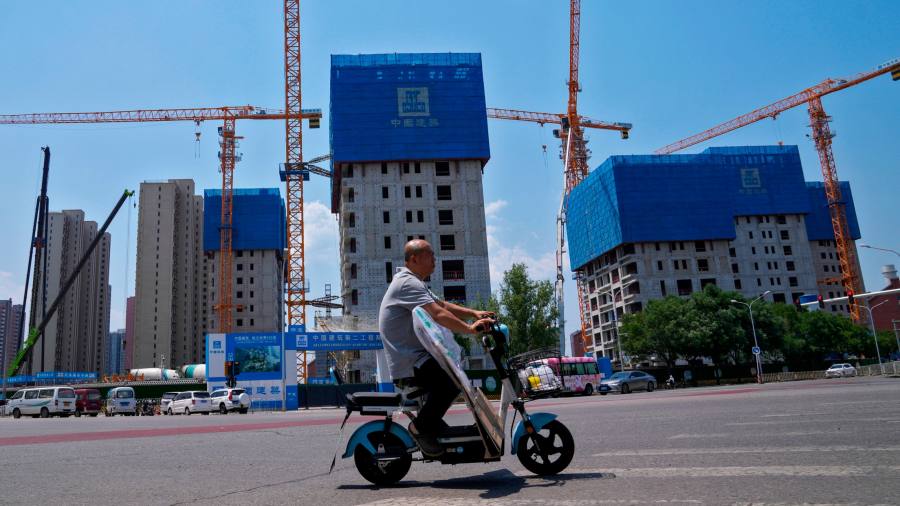
The data release also confirmed that China’s huge property sector was still ailing, more than 18 months after Evergrande, the world’s most indebted developer, was plunged into trouble by default.
New construction starts in the first five months of 2023 were down 23 per cent year-on-year in terms of floor area. New home prices increased slightly from last month but remained lower than in 2022.

China’s Bureau of Statistics said growth in the second quarter would be “much faster” than in the first quarter, when the economy grew by 4.5 percent. But it warned that “the international environment was still complex and grim” and that “the foundations for economic recovery were not yet solid”.
Goldman Sachs wrote in a research note that the pace of recovery is expected to slow further in June and July as the favorable base effect from last year’s lockdown in Shanghai faded.
“We expect more (targeted) easing measures in the coming months, particularly on fiscal and housing, to counter continued weakness in the economy,” Goldman wrote. But the bank cautioned that the magnitude of any stimulus would probably be smaller than in previous easing cycles.
“What this means is that things are still soft (in China), and we will need to lower expectations for the second half of the year,” said Steve Cochrane, chief Asia-Pacific economist at Moody’s Investor Services.
“There have to be some aggressive but very targeted policy measures to get the economy going,” he said, pointing to policy interventions “either a very sharp focus on consumer spending . . . or youth unemployment.” doing something with”.
In currency markets, the renminbi weakened 0.3 percent against the dollar to Rmb7.1807 after the PBoC announced a medium-term lending rate cut, taking the currency down nearly 4 percent against the greenback year to date and a six Went. Month less.
Additional reporting by Andy Lin in Hong Kong

China’s central bank cut its key policy rate for the first time in 10 months as new data reinforced concerns over the post-Covid-19 recovery in the world’s second-largest economy.
The People’s Bank of China lowered its medium-term lending facility rate, the one-year rate that affects bank funding costs, from 2.75 percent to 2.65 percent, amid widespread expectations that Beijing will do more to support the economy. Will be forced to take action.
The rate cut came after the central bank this week unexpectedly raised the seven-day reverse repo rate, a key gauge for short-term banking sector liquidity, and disclosed tax breaks for businesses.
The move, which was accompanied by a dismal data report for May, signaled official dissatisfaction with the state of the Chinese economy, which was widely expected to boom after authorities abandoned strict coronavirus controls at the start of the year .
But growth remains weak due to a slowdown in the property sector, weak demand for exports and a lack of business and consumer confidence.
“We haven’t seen a return to pre-pandemic levels of confidence,” said Julian Evans-Pritchard, China economist at Capital Economics.
Economists predict Chinese policymakers will roll out more support in the coming months, ranging from infrastructure funding to aid to local governments, which bore many of the costs of China’s three-year zero-Covid regime and Much depended on property development for revenue.
Chinese equities were broadly higher after the rate cut, but last month’s poor performance in retail sales and investment limited gains. The Hang Seng China Enterprises index of mainland Chinese companies listed in Hong Kong rose 1.4 percent, while the CSI 300 index of Shanghai- and Shenzhen-listed shares added 0.6 percent.
Data published Thursday by the National Bureau of Statistics reinforced pessimism over China’s growth prospects, putting pressure on the government’s official full-year target of 5 percent expansion, which is already the lowest in decades.
Retail sales and industrial production missed expectations, down 12.7 percent and 3.5 percent, respectively, year on year in May, down from 18.4 percent and 5.6 percent in April. The figures were buoyed by a lower base effect than the widespread lockdowns in China’s biggest cities last year.
“The underlying story on the economy is extremely gloomy right now,” said Robert Carnell, ING’s Asia-Pacific head, in a note to clients. He anticipated more stimulus measures to come, which were more likely to be fiscal than monetary, to encourage spending.
In another sign of Beijing’s struggle to provide enough jobs for young people, youth unemployment hit 20.8 percent, the highest level since records began in 2018. Overall unemployment was stable at 5.2 percent.
The data release also confirmed that China’s huge property sector was still ailing, more than 18 months after Evergrande, the world’s most indebted developer, was plunged into trouble by default.
New construction starts in the first five months of 2023 were down 23 per cent year-on-year in terms of floor area. New home prices increased slightly from last month but remained lower than in 2022.
China’s Bureau of Statistics said growth in the second quarter would be “much faster” than in the first quarter, when the economy grew by 4.5 percent. But it warned that “the international environment was still complex and grim” and that “the foundations for economic recovery were not yet solid”.
Goldman Sachs wrote in a research note that the pace of recovery is expected to slow further in June and July as the favorable base effect from last year’s lockdown in Shanghai faded.
“We expect more (targeted) easing measures in the coming months, particularly on fiscal and housing, to counter continued weakness in the economy,” Goldman wrote. But the bank cautioned that the magnitude of any stimulus would probably be smaller than in previous easing cycles.
“What this means is that things are still soft (in China), and we will need to lower expectations for the second half of the year,” said Steve Cochrane, chief Asia-Pacific economist at Moody’s Investor Services.
“There have to be some aggressive but very targeted policy measures to get the economy going,” he said, pointing to policy interventions “either a very sharp focus on consumer spending . . . or youth unemployment.” doing something with”.
In currency markets, the renminbi weakened 0.3 percent against the dollar to Rmb7.1807 after the PBoC announced a medium-term lending rate cut, taking the currency down nearly 4 percent against the greenback year to date and a six Went. Month less.
Additional reporting by Andy Lin in Hong Kong