















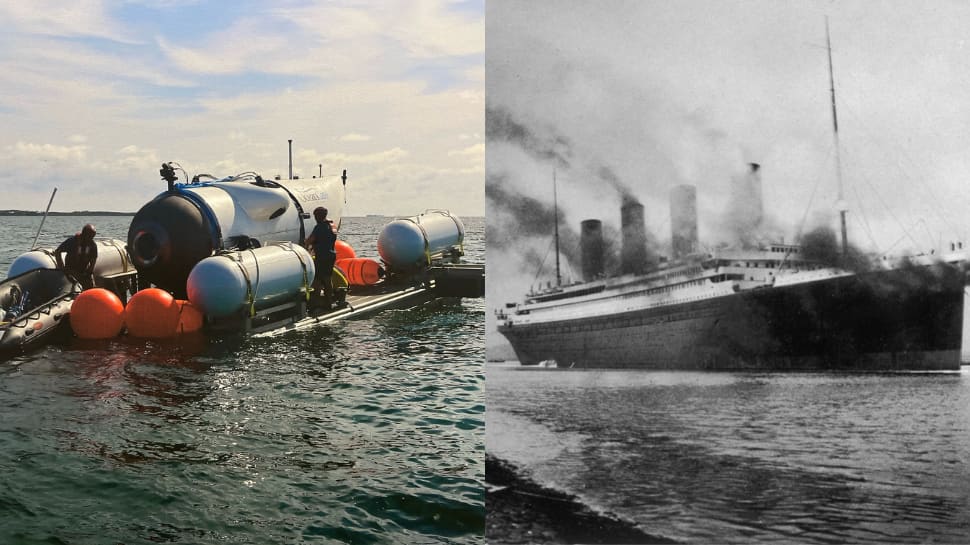

New Delhi: The race against time to find a submarine that disappeared en route to the Titanic wreck site entered a new phase of desperation on Thursday morning as the tiny ship was possibly on its last hours of oxygen. Rescuers have sent more ships and vessels to the site of the missing in the hope that for the second day in a row underwater sounds have been detected, which could help narrow their search in an immediate, international mission. But when the ship, called the Titan, set sail at around 6 a.m. on Sunday, the crew only had a four-day supply of oxygen.
Even those expressing optimism warned that many hurdles remained: from pinpointing the ship’s location, to reaching it with rescue equipment, to lifting it to the surface, assuming it was still intact. But till And all this before the passengers’ oxygen supply runs out.
The entire area being searched was twice the size of Connecticut in water as deep as 13,200 feet (4,020 m). Capt. Jamie Fredericks of the First Coast Guard District said authorities still hoped to rescue the five passengers on board. “It is 100% search and rescue mission,” he said on Wednesday.
Also read: Who is British billionaire Hamish Harding who helped India get Namibian cheetahs aboard the missing Titanic submarine?
The region of the North Atlantic where the Titan disappeared on Sunday is also prone to fog and stormy conditions, making it an extremely challenging environment to conduct search and rescue operations, said Donald, an oceanographer who serves as the coast’s chief scientist. Murphy said. Guard’s International Ice Patrol.
Meanwhile, newly unearthed allegations reveal that significant warnings about ship safety were raised during the submarine’s development. Frederick said that although the sounds detected offer an opportunity to narrow down the search, their exact location and source have yet to be determined. “To be honest, we don’t know what they are,” he said.
Also Read: 10 Things To Know About Ocean Gate’s Missing Titanic-Bound Submarine
Retired Navy Capt. Carl Hartsfield, now director of the Woods Hole Oceanographic Systems Laboratory, said the sounds were described as ‘thumping noises’, but he warned that the search team had to “put the whole picture together in context”. Have to keep and they have to do that.” Eliminate possible man-made sources other than Titan.”
The report was encouraging to some experts because submarine crews unable to communicate with the surface are taught to bang on their submarine’s hull to be detected by sonar. The US Navy said in a statement on Wednesday that it is deploying a specialized rescue system capable of lifting large, heavy and bulky undersea objects such as aircraft or small ships.
Titan weighs 20,000 pounds (9,071 kg). The US Navy’s Flyaway Deep Ocean Salvage System is designed to lift weights of up to 60,000 pounds (27,216 kg), the Navy said on its website. The lost pilot on board is Stockton Rush, CEO of the company leading the expedition. His passengers are a British adventurer, two members of a Pakistani business family, and a Titanic expert. The OceanGate Campaign oversaw the mission.
The 22-foot (6.7-meter) carbon-fiber vessel was delayed Sunday night, prompting a search in waters about 435 miles (700 kilometers) south of St. John’s, officials said. Officials have said the ship had a 96-hour oxygen supply, giving them a Thursday morning deadline to find and raise the Titan.
Submarine search and rescue expert Frank Owen said the estimated oxygen supply is a useful ‘target’. For searchers, but this is only based on a “nominal amount of consumption”. Owen said divers aboard the Titan will likely be advising passengers “to do anything to lower your metabolic level so you can actually increase it.”
In 2021 and 2022, at least 46 people have successfully traveled from Oceangate’s submersibles to the Titanic wreck site, according to papers filed by the company in the US District Court in Norfolk, Virginia, which oversees cases related to the Titanic wreck. One of the company’s first customers described a dive carried out at the site two years ago as a ‘kamikaze operation’.
Imagine a metal tube a few meters long with a sheet of metal for a floor. You can’t stand it. You can’t kneel. Is everyone sitting close to or above each other? said Arthur Loibel, a retired businessman and adventurer from Germany. ‘You can’t be claustrophobic.’
During the 2.5-hour descent and ascent, the lights were turned off to save energy, the only light coming from a fluorescent glow stick, he said. The dive was repeatedly delayed to fix problems with batteries and balance weights. In total, the journey took 10.5 hours.
OceanGate has been criticized for its use of a simple commercially available video game controller to control the Titan. But the company has said that many of the ship’s parts are not ready yet because they have been proven reliable.
“It’s for a 16-year-old kid to throw it around, and it’s ‘super durable’,” Rush told the CBC in an interview last year, when he demonstrated by throwing the controller around the Titan’s tiny cabin. They did. They said something ‘just in case’ extra parts are kept on board. The submersible had seven backup systems for return to the surface, including sandbags and lead pipes that would collapse and an inflatable balloon.
Jeff Carson, a professor emeritus of earth and environmental sciences at Syracuse University, said temperatures are just above freezing point, and the vessel is too deep for human divers to reach it. The best chance to reach the submersible may be to use a remotely operated robot over a fiber optic cable, he said. Carson said, “I bet it’s awful out there.” It’s like living in an ice cave and hypothermia is a real danger.
Documents show that Oceangate was warned that the way the experimental vessel was developed could pose catastrophic safety problems. David Lockridge, Oceangate’s director of marine operations, said in a 2018 lawsuit that the company’s testing and certification was insufficient and that “passengers would face potentially extreme danger in an experimental submarine.”
The company insisted that Lockridge “was not an engineer and was not hired or asked to perform engineering services on Titan.” The firm also says that the ship under development was a prototype, not the now-missing Titan.
The Marine Technology Society, which describes itself as “a professional group of marine engineers, technologists, policy-makers and educators”, also expressed concern in a letter to Oceangate chief executive Rush that year. The society said it was important that the company submit its prototype for tests to be overseen by an expert third party before launch for the safety of passengers. The New York Times first reported on those documents.
The lost travelers on Titan are British adventurer Hamish Harding; Pakistani nationals Prince Dawood and his son Sulaiman, whose nominated firm makes investments across the country; and French explorer and Titanic expert Paul-Henri Nargolet.
Retired Navy Vice Admiral Robert Murett, who is now deputy director of the Institute for Security Policy and Law at Syracuse University, said the disappearance underscores the dangers associated with working in deep waters and the recreational exploration of the ocean and space.
“I think some people believe that modern technology is so good that you can do things like this and accidents won’t happen, but that’s not the case at all,” he said.


