Get free updates from the war in Ukraine

we will send you one myFT Daily Digest Latest Email Rounding war in ukraine News every morning.
The author is Senior Fellow at the Carnegie Russia Eurasia Center, Berlin and Visiting Fellow at the European University Institute, Florence.
Vladimir Putin appears to have overcome his biggest domestic crisis since the Chechen war that began his reign. But the Russian president’s allies at home and abroad are in no hurry to congratulate him. The mood of the elite and the tone of official propaganda are not triumphant. The very prospect of a coup after 23 years of rule and the second year of the Ukraine war – a cover-up campaign to glorify Putin and his regime – puts his grip on Russia into question. It also challenges the idea of unanimous support of a patriotic majority.
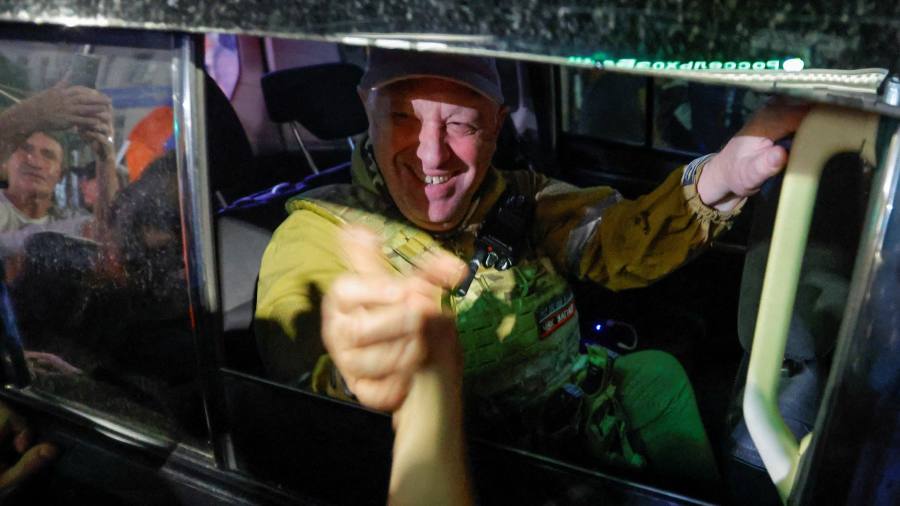
The capture of one of Russia’s largest cities, Rostov-on-Don, by the leader of Wagner Military Group Yevgeny Prigozhin, and his rapid advance to within 200 km of Moscow, painted a shocking picture of the powerlessness of the authorities, even though Partly explained by a desire to avoid bloodshed. Some residents of Rostov even handed flowers to the rebels of the private military company. The people of a country who had been taught by state propaganda that there was no greater betrayal than “colour revolutions”, re-enacted the typical symbolic gesture of such revolts.
Prigozhin’s rebellion was rooted in the disruption of the internal balance that Putin had maintained for years, but which began to collapse after the invasion of Ukraine. Many Russian citizens refuse to acknowledge their country’s weakness. He blames the defeat in Ukraine on indecision and betrayal at the top level. Failures at the front have given rise to calls for increased militarization of the economy and a purge of the elite. Prigozhin’s vision for Russia went even further: a vast North Korea, with a fully functioning population and economy, at least until victory.
Prior to the invasion, Prigozhin’s role in the Russian system was that of a service provider. With Wagner and his troll factory, the ex-convict was doing Putin favors by engaging in tasks the state has been reluctant to take on in its name: intimidating domestic enemies, interfering in foreign elections, and fighting in Africa. As a result, an increasingly ambitious non-state entity with state functions emerged.
With Russia’s full-scale invasion of Ukraine and Wagner’s significant contribution to the war, Prigozhin’s assignments changed. He ran public campaigns marked by provocative statements on domestic and foreign policy. His calls to punish the state apparatus and organize private business earned him a lot of support in a short time.
Prigozhin decided to cross the border after 10 June, when Defense Minister Sergei Shoigu issued an order placing “volunteer” combat formations under his ministry. This put Prigozhin at risk of losing his main power asset at the hands of Russia’s official armed forces. However, he did not directly challenge Putin, for good reasons. During two decades in power, Putin has become so intertwined with the Russian state in the public eye that, for many, turning against him would be tantamount to an attack on Russia itself.
It appears that Prigozhin’s goal was not to overthrow but to partially replace the ruler. Shoigu’s removal would have allowed Prigozhin to demonstrate his importance not only as a mercenary commander but as a politically influential figure. Prigozhin’s attack on Shoigu, whose military successes in Crimea and Syria have made him the regime’s second most popular figure behind Putin, was an attempt to secure that position for himself.
Putin has avoided the worst-case scenario: civil war-style clashes between “patriots”, bloodshed and the shelling of cities by the military. The state apparatus, especially in the regions of Russia, showed at least passive loyalty. But all this happened at the cost of tremendous pressure on the system. Prigozhin’s actions put the pro-war camp, which greatly respected him, in a difficult position. The charges of treachery often leveled at opponents of the war can now be leveled at some of its supporters. The official dividing line between “good” and “bad” Russians, or “patriots” and “traitors”, is no longer clear.
Russia’s “patriotic majority” has always suspected the country’s wealthy rulers and private business elite of being indifferent to national interests and the common people. This was precisely Prigozhin’s claim, and it will continue to resonate despite his apparently being sidelined.
Putin must either continue to act in the precarious role of protector of a “corrupt elite” or, under the pressure of last weekend’s events, liquidate that elite. In this sense, Prigozhin’s bold act could end not only the present form of Putin’s regime, but also the entire legacy of post-Soviet Russia.